32 private links
The pipe belonged to Tesla. The dark liquid was wastewater from the company’s nearly $1 billion lithium refinery, which began operations in December 2024 and was, at the time, the first commercial-scale spodumene-to-lithium-hydroxide refinery in North America. Tesla had marketed the plant for years as an “acid-free clean process,” promising sand and limestone as the main byproducts. The drainage district had not been told that 231,000 gallons of treated wastewater per day would be flowing through its infrastructure.
The flash crash happened when Sarao's algorithm had been turned off, and the price should have been rebounding

62 percent of Ottawa neighbourhoods got faster by car between 2019 and 2025, compared to 18 percent that got faster by transit
The list submitted by Tehran includes demands for compensation for war damage sustained during the now 10-week conflict, as well as recognition of Iranian sovereignty over the vital Strait of Hormuz shipping route.
Trump is highly unlikely to agree to pay Iran reparations linked to the war, nor support Iranian sovereignty over the Strait of Hormuz—the largely closed-off passageway through which one-fifth of the world’s oil supply normally passes.
Illo illustration of a man and woman in a gas mask in front of a survival shelter
The Trump administration has also said it will not come to the table unless Iran agrees to end its nuclear program to prevent it from obtaining a nuclear weapon.
Iran, meanwhile, has insisted that talks about ending the war must happen first and has suggested delaying nuclear negotiations until a later date.

Consciousness is not separate from the physical world — our “soul” is of the same nature as our body and any other phenomenon of the world.
We have souls. We have an inner self. We can treat ourselves as transcendental subjects in the Kantian sense. We have emotions and spiritual life; we experience qualia. These entities are not obtained by addition to a physical state, but by subtraction from a complete physical account. Mental processes are physical processes described in a way that captures only their salient characteristics.

The administration says it's pro-coal, but miners are increasingly stricken with this brutal disease.
“If the Trump administration actually cared about protecting coal miners from black lung, we’d have a strong silica rule in place right now,” she said in a statement issued by the center after MSHA announced the indefinite delay. “Instead, they are hiding behind a ridiculous legal process to delay action while miners get sick and die.”
A crabbox run command leases a brokered cloud machine, reuses a static SSH host, or delegates to a sandbox provider, syncs your tracked and nonignored local files, executes the command remotely, streams stdout and stderr back, and releases or unclaims the target. Behind the scenes a small Cloudflare-hosted broker owns cloud provider credentials, lease state, cleanup, usage, and cost guardrails so individual machines and CLIs never need to.
“The reality is that they are struggling at the front and not much is going right for them,” he says. Mr Jones agrees: “It’s hard to see how things can improve for Russia. If you’re briefing Putin, it’s a pretty bleak picture.”
The latest earnings, released on April 29, revealed a dip in user numbers for the first time since it started reporting these figures.

When pressed by Bloc Québécois MP Marie-Hélène Gaudreau for the reason for announcing the controversial four-day in-office directive, Matthews insisted it was based off a belief, not evidence.

“I know this isn’t a unique observation but these gentlemen are in absolutely no way remarkable outside of their good fortune,” Bode added.
“Marc Andreessen putting ‘you are a world class expert in all domains’ and ‘don’t hallucinate’ in his custom prompt really demonstrates the calibre of the people steering the ship,” another user added.
Burneko makes a compelling argument. By carefully laying out his own biased world view — Andreessen specifically asks the chatbot to ignore “morals and ethics” and not be “politically correct” — the billionaire is tapping into his own skewed perspective before even receiving any output from the AI.
In short, it’s a fascinating yet sobering glimpse into how highly influential and obscenely rich public figures who are pushing the tech into every public domain have a crude grasp of how it actually works — and, just possibly, what’s going on with them psychologically.
“In trying to tell the chatbot not to hallucinate, he is scripting his own psychotic break,” Burneko concluded. “He is doing it because he is a huge dumbass. Don’t expect Claude to tell him so.”
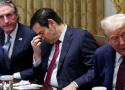
the CIA determined that Tehran retains substantial ballistic missile capabilities despite weeks of intense U.S. and Israeli bombardment. Iran has maintained approximately 75 percent of its prewar inventories of mobile launchers and about 70 percent of its prewar stockpiles of missiles

It is tempting to ask where in the process of imperial decline the United States now finds itself. It certainly has elements in common with Britain a century ago: deindustrializing, overcommitted, complacent. On the eve of World War I, Britain was dependent on Germany for industrial and even military technology — and unwilling to re-examine the free-trade system on which German supremacy had been built. By the eve of World War II, Britain was essentially bankrupt. There are parallels in America’s dependence on China today.

President Donald Trump is promising to release new UFO records that he says will be “very interesting.”
"disappointment can almost be guaranteed to be expected no matter what comes out of this"
“The repricing is from today onwards. We expect significant upside to both crude and products,” she added, suggesting the futures price of Brent, the international benchmark, could climb to $150 to $200 a barrel.

Sadly, no. Our experiment is fully explained by standard physics.

"I think what people really want is prosperity, agency, the ability to have an interesting life, and to be fulfilled and have some impact," he said.