32 private links

“The material in the tables came from one man, an extraordinary man with incredible numbers of sexual experiences on which he kept very careful notes…Kinsey gives the impression that the data came from three or four men, but it was just the one,” Bancroft said while raising aspersions on the validity of the findings of the Kinsey Reports.

Some poor countries struggling to repay China now find themselves stuck in a kind of loan limbo: China won’t budge in taking losses, and the IMF won’t offer low-interest loans if the money is just going to pay interest on Chinese debt.


On the other side, a possible point of contact might be Konstantin Kilimnik, who the FBI believes has ties to Russian intelligence. A former employee of Manafort’s firm, Kilimnik was sometimes described as “Manafort’s Manafort,” while Manafort reportedly called him “my Russian brain.” A poorly redacted court filing from Mueller’s team inadvertently revealed that Manafort gave Kilimnik detailed polling information during the campaign and discussed a Ukrainian peace plan, then lied about both to Mueller, even when he was supposedly cooperating. Mueller charged Kilimnik with conspiracy to obstruct justice and obstruction of justice for allegedly attempting witness tampering during the Manafort investigation.

Using multicolored flow charts in an attempt to simplify complex transactions, prosecutors tried to show that Mr. Manafort concealed more than $60 million in income in 31 foreign bank accounts opened in the names of shell companies.
The money came from Ukrainian oligarchs who paid Mr. Manafort to boost the political career of Viktor F. Yanukovych, a pro-Russian politician who, with Mr. Manafort’s help was elected president of Ukraine in 2010.



In pre-trained transformer models (GPT), fine-tuning occurs in the Decoder. The decoder is responsible for generating the output text based on the representation created by the encoder. Like the encoder, the decoder is typically made up of multiple layers of multi-head self-attention and feed-forward neural networks.

Trump Administration United States Department of Justice official wrote in a New York Times op-ed that “white supremacy and far-right extremism are among the greatest domestic-security threats facing the United States. Regrettably, over the past 25 years, law enforcement, at both the Federal and State levels, has been slow to respond. … Killings committed by individuals and groups associated with far-right extremist groups have risen significantly.”

Seventy-one percent of the 387 “extremist related fatalities in the United States” from 2008 to 2017 were committed by members of far-right and white-supremacist groups, according the Anti-Defamation League’s Center on Extremism. Islamic extremists were responsible for 26 percent.

git filter-branch --index-filter 'git rm -rf --cached --ignore-unmatch path_to_file' HEAD

The main reason for the drop in corporate tax revenue is obvious: The TCJA slashed the corporate rate by 40 percent, from 35 percent to 21 percent. But the falloff in corporate revenue has been even sharper than expected.
Several months before the TCJA was enacted, the Congressional Budget Office (CBO) projected that corporate tax revenues for fiscal years 2018 and 2019 would total $668 billion. In the forecast published soon after the TCJA was enacted, however, the CBO projected $519 billion in corporate tax revenue over those two years—a $149 billion decrease. Actual corporate tax revenue over that period came in significantly lower, at $435 billion—a $233 billion drop. Essentially, corporations have already received $233 billion in tax cuts, $84 billion more than the CBO projected. To put that in perspective, the federal government spent just $47 billion on Pell Grants over the past two years.
The CBO’s adjusted forecasts now put the 10-year cost of corporate tax cuts at roughly $750 billion, $400 billion more than the pre-TCJA projections. That figure includes the temporary revenue from the TCJA’s repatriation provision, which gave corporations steeply discounted tax rates on stockpiles of overseas profits from prior years.
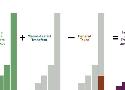

Revenues from corporate taxes have generally been declining as a share of GDP, in part as a result of lower tax rates and the increase in the prevalence of pass-through businesses.

Corporate income taxes accounted for 6 percent of total U.S. tax revenue in 2021.
This is partially because more than half of business income in the United States is reported on individual tax returns. Relative to other OECD countries, the U.S. approach to taxing business income boosts the share of tax revenue from individual income taxes in the U.S. and reduces the share of corporate tax revenue.

State governments collected $52 billion in revenue from corporate income taxes in 2020, or 2 percent of state general revenue.
using 2027 estimate only, impact by tax brackets:
<$30k pay 43.5bln
$30-75k pay 17.4bln
$75-500k receive 16bln
$500k+ receive 12bln
my sheet: https://docs.google.com/spreadsheets/d/1tp_KFL0cta_iyi3MHhqoMTI-E4gaL4xfYm50wYf4n00/edit?usp=sharing